
A Stable Ledger for the Age of Titans
A buyer's companion to the stranger steeds of Alluria, priced for the present age and annotated for the customer who wishes to know exactly how much trouble they are getting into. Every beast below can be saddled. Not every beast below should be.The Stable Ledger
Beasts are listed from the humblest to the most exalted. The first price buys a riding animal, sound on the road but liable to panic in a fight. The second buys one schooled for war. Tap a name to turn to its full entry.
| Beast | Level | Size | Rarity | Riding | War-Trained |
|---|---|---|---|---|---|
| Kairuku | 1 | Medium | Common | 7 gp | 20 gp |
| Sand Runner | 1 | Large | Common | 10 gp | 20 gp |
| Battle Bird | 2 | Large | Common | 10 gp | 30 gp |
| Roak | 2 | Large | Common | 12 gp | 30 gp |
| Bahtel | 2 | Large | Common | 14 gp | 35 gp |
| Vuhr | 2 | Large | Common | 15 gp | 35 gp |
| Grey Auroch | 3 | Large | Common | 20 gp | 60 gp |
| Bounder | 3 | Large | Common | 22 gp | 55 gp |
| Steeder | 3 | Large | Uncommon | 25 gp | 60 gp |
| Lanternpard | 3 | Small | Rare | 30 gp | 65 gp |
| Riding Basilisk | 4 | Large | Uncommon | 40 gp | 100 gp |
| Blue Cat | 4 | Large | Uncommon | 42 gp | 105 gp |
| Thunder Lizard | 4 | Large | Uncommon | 45 gp | 110 gp |
| Guardian Stag | 4 | Large | Rare | Never sold | |
| Whale Bear | 5 | Large | Uncommon | 60 gp | 160 gp |
| Dreadstrider | 5 | Large | Rare | 65 gp | 160 gp |
| Polar Reindeer | 5 | Large | Rare | 70 gp | 175 gp |
| Yali | 6 | Large | Rare | 100 gp | 250 gp |
Kairuku
Creature 1Speed 25 feet, swim 40 feet; Price 7 gp riding, 20 gp war-trained
Great flocks of kairuku strut and dive along the icy shorelines of the far south. The species went extinct in the deep past, but one flock, sealed whole in glacier ice, was traded from the kul to the squawks as frozen curiosities. There the birds sat on display until qulari rogues stole one, sold it to their own kin, and had it thawed and resurrected. The creature that emerged so delighted everyone involved that the entire flock soon followed it back to life, and the kairuku have multiplied happily ever since.
A tamed kairuku is utterly loyal above and below the waves, and squawks favor them as mounts for both. Buyers are warned of the breed's one vice: kairuku adore shiny objects, and a rider wearing polished silver may be mobbed by a whole flock of admirers with quick beaks and no shame.

Sand Runner
Creature 1Speed 45 feet; Price 10 gp riding, 20 gp war-trained
The greyhounds of the horse world, sand runners are lean, long-legged, and tireless, able to travel 15 hours a day on three quarters of a horse's water. They swim well, never lose their way, and will carry word or cargo without a rider to any destination they know. A sand runner is clever enough to learn simple commands and recognize a coat of arms, so its loyalty extends to anyone in a household who knows the proper signs. Once per day a healthy runner can raise its Speed to 80 feet and hold that sprint for half an hour, which is usually enough to leave the trouble behind.
Buyers should mind the breed's limits. Sand runners are poor fighters that would rather flee, they dislike barding, and they turn slow and sulky in the rain. Magic does not trouble them at all, but fire in any form sends them bolting. Their coats run from butter yellow to golden brown, often banded in darker stripes, and a well-kept runner serves for 25 years.

Battle Bird
Creature 2Speed 50 feet; Price 10 gp riding, 30 gp war-trained
Also called axe beaks, these flightless cousins of the ostrich stand 10 feet tall, all leg and neck beneath a beak like a headsman's tool. A battle bird is fearless, swift, and profoundly stupid. It outruns most horses, turns tighter than any of them, and fights happily in alleys and stairwells where a warhorse cannot maneuver, staving in shields with its kick and doing worse with its bite.
The breed has firm opinions. A battle bird refuses to take a single step while overloaded, prefers unarmored or Small riders, and requires constant supervision, which is why halfling and gnome lancers, who weigh little and watch closely, favor them above all other mounts. Battle birds eat nearly anything, from small prey to table scraps, and guard their enormous yearly eggs with real devotion.

Roak
Creature 2Speed 25 feet; Price 12 gp riding, 30 gp war-trained
Roaks are beetles grown to draft size, their folded wing cases sheathing them as well as full plate, though those wings will never lift them and their six bristled legs will never outpace a mule. What they offer instead is placidity, obedience, and a shell that shrugs off arrows. A roak is fearless because it lacks the imagination for anything else, obeys every command without hesitation, and hauls loads that would break an ox. They taste the world through their feelers and eat whatever proves organic, grinding it so thoroughly that nothing short of a wish can bring a devoured creature back.
Herd-minded and thoroughly domesticated, roaks are as common in some regions as cattle, and are likewise raised for meat, a high protein flesh with the flavor of rancid oatmeal that dromaar and goblins consider a delicacy. Keep them out of the north: below 55 degrees a roak grows sluggish, moving as if slowed, and at a hard freeze it simply stops, locked in harmless suspension until the thaw.

Bahtel
Creature 2Speed 40 feet; Price 14 gp riding, 35 gp war-trained
Berserker horses, the stablehands call them. Bahtel are broad, thick-boned horses with long flexible necks, striped in wide bands of gray, white, and black like no natural breed, and they love a fight the way other horses fear one. In battle a bahtel bites, batters with its bony forehead, and lashes out with both ends; a rear kick that lands squarely can knock a grown warrior prone. They rarely panic, though a wounded bahtel facing poor odds has sense enough to retreat.
Staying aboard one is the hard part. A frenzied bahtel bucks and twists hard enough to throw any unpracticed rider, and casting spells from its back mid-fight is a fool's errand. They accept any barding and ordinary saddles but need bitless bridles for their heavy jaws. Loyalty follows the feed bucket, with a marked preference for bold, skilled riders. Bahtel are omnivores of hot, wet country that suffer badly in the cold, mature in a single year, and live about twelve. Mares run larger and meaner than the stallions.

Vuhr
Creature 2Speed 30 feet; Price 15 gp riding, 35 gp war-trained
Vuhr are tall, placid beasts of burden, orange or red of coat, horned at the temples, and related to horses the way a fortress is related to a cottage. A vuhr carries more than any horse alive and does it up grades that would stop a mule, on great hard hooves made for stone. Many bulls and some cows grow six legs rather than four, and the six-legged specimens are the largest and strongest of all. Their one terror is enclosure: a vuhr will enter no cave, tunnel, or cellar, making exception only for a familiar stable.
They are calm, tractable, and braver than they look. A charging or wounded vuhr lets out a bellow that can shake the fight out of whoever stands before it, leaving the faint-hearted frightened, and a faithful vuhr holds its ground beside a dismounted rider until driven off. They can smell poison at a hand's breadth if no stronger scent masks it. Barding must be fitted custom at half again the usual price. Vuhr dislike dwarves for reasons no vuhr has ever explained, delight in smaller folk, and will cheerfully carry three halflings at once for 30 years and more.

Grey Auroch
Creature 3Speed 35 feet; Price 20 gp riding, 60 gp war-trained
The grey auroch is a riding ox of uncommon size and stranger blood, its silver coat faintly luminous under moonlight and its deep blue eyes unsettlingly knowing. Its horns are the tell: they draw and hold the small energies of storm and season, and herds are often found grazing untroubled at the heart of weather that scatters ordinary cattle. A mount whose horns spark faintly before the lightning falls has saved more than one caravan.
For all that, the breed's real value is plainer. A grey auroch walks from dawn to dusk without complaint, carries armor and rider without strain, and meets danger with a low, level stare rather than panic. Its keen senses give fair warning of trouble on the road, and its loyalty, once earned through shared miles, does not lapse.

Bounder
Creature 3Speed 45 feet; Price 22 gp riding, 55 gp war-trained
The bounder is a bipedal riding lizard bred in the cities for strength, set to wagon teams in harness and to war under saddle. Its thick hind legs bear rider and load across loose sand and gravel without breaking stride, while its long forelimbs end in claws that handlers file to points or shoe with metal blades; more than one house has had those blades enchanted. Heavy scales armor its back, neck, and skull above a soft leathery underside, in colors from sandy yellow to a green so deep it reads as black.
Bounders drool, snort a crude language of grunts at one another, and fight with bite and foreclaws when carrying a rider, since the hind claws are busy holding everything up. Breeding pens are kept by noble families, merchant houses, and more than one crowned head, though enough bounders have slipped away from caravans and battlefields over the years that wild herds now run with escaped stock in their lines.

Steeder
Creature 3Speed 40 feet, climb 25 feet; Price 25 gp riding, 60 gp war-trained
Surface steeders were bred by wartime mages to answer the drow spider-cavalry of the deep roads, a magical cross of horse and giant spider that kept the best of both. The body is a horse's; the eight legs beneath it are not, and they carry a steeder over rubble, scree, and sheer stone faces that no hoofed animal could attempt. Riders use harnessed climbing saddles for the vertical work, and the beast can anchor itself, or a falling ally, with cast strands of web.
Steeders are herbivores without a trace of their spider parent's venom, and they never truly sleep, some part of the animal always keeping watch. Their odd frame means standard horse barding will not fit, and custom barding costs dearly. A mated pair produces two eggs in a lifetime, and the colts that hatch are grown within the year.

Lanternpard
Creature 3Speed 25 feet, fly 40 feet; Price 30 gp riding, 65 gp war-trained; Riders Tiny only
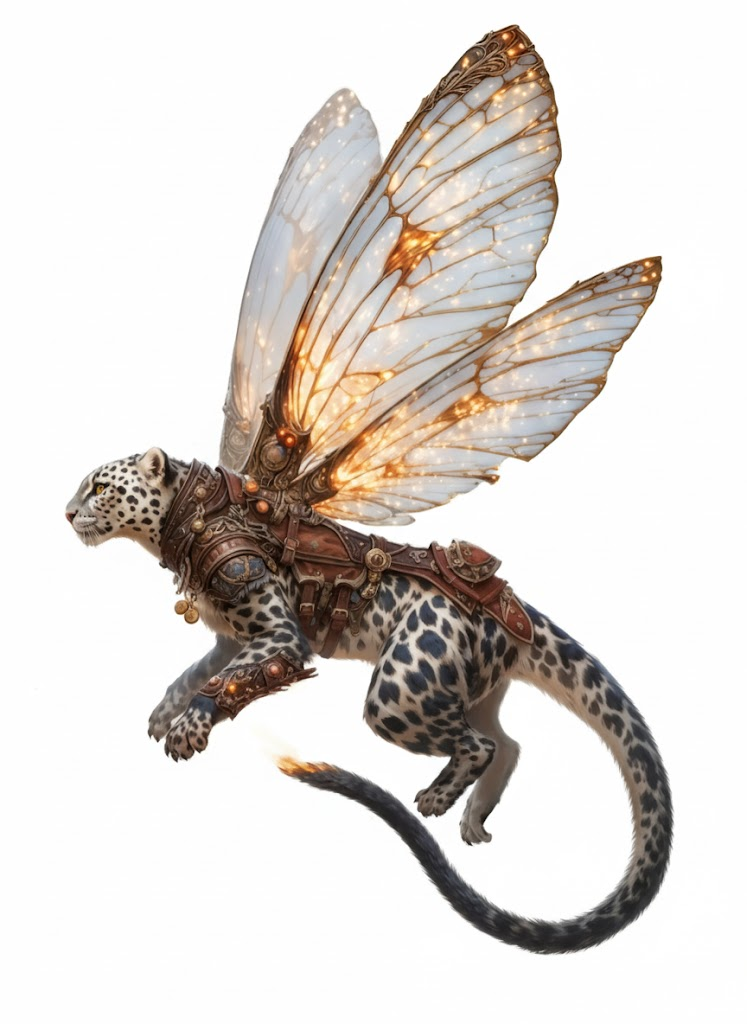
When the fey realm rose to hang above Alluria as the First World, the lanternpard came with it: a snow-spotted cat no bigger than a hound, bearing two pairs of gossamer wings veined in living gold. The wings shed dim light in a 10-foot radius, brightening and fading with the little cat's mood, and courtiers of the First World read a lanternpard's temper by its glow the way sailors read the sky.
It is the mount of the smallest gentry. Only Tiny riders can sit one, and pillywiggin knights, sprig couriers, and sprite huntsmen prize them beyond gold, which is fortunate, since a lanternpard is more often won through a fey bargain than bought with coin. A mounted lanternpard hunts in silence, wings dimmed to embers, then blazes at the pounce. They are vain as princes, fond of polished ornaments, and inclined to sulk in the dark, literally, when ignored.
Riding Basilisk
Creature 4Speed 30 feet, swim 20 feet; Price 40 gp riding, 100 gp war-trained
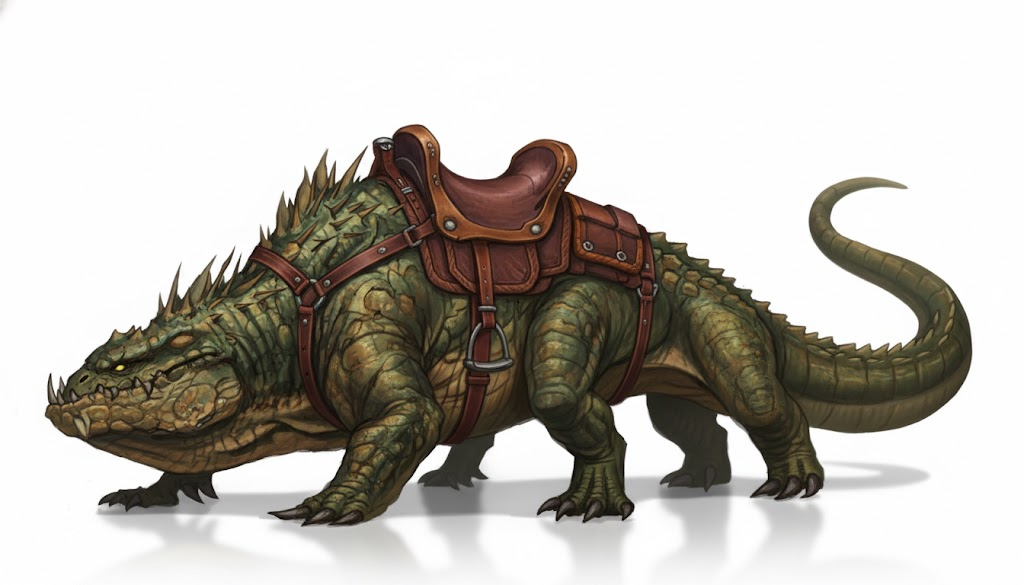
Breeders of the Apophan Covenant needed generations to cull the stone-turning gaze from their basilisk lines, and every riding basilisk worth its price is sold with a written pedigree certifying the bloodline gaze-blind. Old habits linger: most handlers still blinker the beasts in town, more for the townsfolk's comfort than for any danger. What the breed kept is the venom, a numbing bite that deadens muscle rather than turning it to stone, leaving struck prey clumsy and sluggish while the basilisk takes its time.
As a mount it is patience on squat legs, tireless at a low swaying walk, indifferent to heat, mire, and river crossings, and content to lie for hours as a living blind for hunters. It will never win a race. It will still be walking when everything that could have won one has foundered.
Blue Cat
Creature 4Speed 40 feet, climb 20 feet; Price 42 gp riding, 105 gp war-trained
Largest and most feared of the great cats, the blue cat wears pale blue fur under dark vertical stripes, crowned with two great twisting horns. It can spring 10 feet straight up or cover 50 feet in a single pouncing leap, swims and climbs with equal grace, and holds the top of the food chain in every wilderness it inhabits, from tundra to jungle. Females raise their cubs alone and keep them close for years.
Under saddle, a well-treated blue cat guards its rider with the ferocity of a fiend, carries out spoken commands without supervision, and keeps a sustained pace few horses match. It has terms. A blue cat carries Medium riders and light loads only, accepts nothing heavier than leather barding, and repays mistreatment in kind, which the barbarian tribes who favor these mounts consider a fair and clarifying arrangement.

Thunder Lizard
Creature 4Speed 40 feet; Price 45 gp riding, 110 gp war-trained
Thunder lizards are named for their loose scale plates, which slap together as the animal moves. At a walk it is a dry clatter; at a full charge it is a rolling series of thunderclaps that announces the lizard to everything ahead of it. The breed grew fast because it had to, since nothing that loud ambushes its dinner, and these hill-country predators run down prey in the open with shocking speed and a voracious appetite.
As battle mounts they have few equals. The noise that ruins their hunting makes a cavalry charge sound like the sky falling, and the animal beneath the din brings strength, aggression, and a bite that punches through mail. Their hide is armor already, and their strength carries true barding besides, though smiths charge double to fit it.

Guardian Stag
Creature 4Speed 45 feet; Price never sold; a guardian stag chooses its rider
Guardian stags are born, rarely and without warning, to ordinary deer, and no sage agrees on why. Some credit stray magic, some the gods, some a forest's own need answering itself. Whatever the cause, the result is a stag of unusual size, keen intelligence, and tireless speed, sworn by its nature to the defense of its home wood against all threats, within and without.
No coin buys one. A guardian stag suffers no halter and no stable, and allows a rider only when its forest stands in dire and immediate peril, seeking out a worthy defender and offering itself for the length of the fight. Elven champions have ridden to war this way, and so have plain woodsfolk and, on one recorded occasion, a dryad. Those so honored should note that barding, if the stag consents to wear it at all, must be custom fitted at nearly a third again the usual price.

Whale Bear
Creature 5Speed 35 feet, swim 50 feet; Price 60 gp riding, 160 gp war-trained
Whale bears, called qulari akhluts in the south, wear the shape of the magical akhlut without a drop of magic in them; the two evolved on opposite poles and are likely no relation at all. The resemblance runs deep regardless, down to the wolf-like body, eyes that see clean through a blizzard, and a bite that opens a seal like a purse. When the two kinds meet, the whale bear goes submissive at once and has been known to fight on its magical twin's behalf.
The qulari domesticated them first and traded breeding stock to the thanor of the far north, whose imported packs now roam the Arctic circle and outnumber the native akhlut there. Whale bears make ferocious mounts and war-beasts with one flaw no breeding line has ever removed: now and then, a whale bear eats its master. The thanor keep the best record with them, mostly because a thanor cannot be swallowed whole. Many consider the trait worth the risk regardless.

Dreadstrider
Creature 5Speed 40 feet; Price 65 gp riding, 160 gp war-trained
Death is an ending to most, but it is also a residue, and a horse that outlives its rider on the battlefield sometimes carries a measure of it away. Pass that inheritance to a foal and a dreadstrider is born; foals dropped on the battlefield itself are said to carry more of the grave in them still. The look confirms the story: a gaunt frame, articulated feet, fangs where a horse has none, and eyes gone black to the rim.
An aura of quiet death hangs about the animal. Ordinary beasts refuse to share a paddock with one, and the faint of heart find they cannot bring themselves to mount. Those who can discover an ordinary horse underneath, loyal, steady, and willing, content with any stable's hay and oats, though it takes carrion the way other horses take apples.

Polar Reindeer
Creature 5Speed 40 feet, fly 40 feet (see entry); Price 70 gp riding, 175 gp war-trained
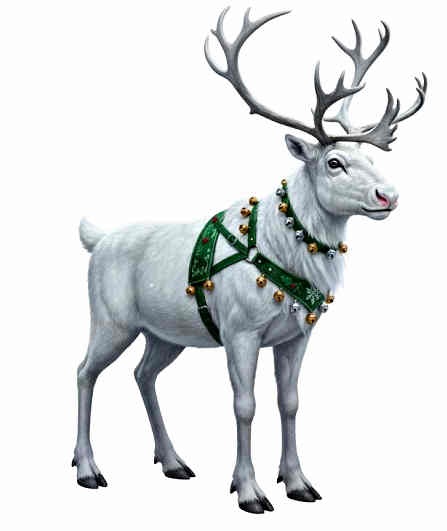
In the farthest north, where winter is the landlord and daylight only visits, the tomte and julenisse keep herds of white reindeer that do not stop where the ground does. Given a running start, a polar reindeer strides up onto the air as if onto a firm drift and gallops the open sky, so long as it keeps its legs moving; if it halts aloft, it does not fall but settles gently downward like snow. On midwinter night the herders yoke teams of them to sleighs and cross entire provinces between dusk and dawn, delivering gifts, grudges, and gossip in roughly equal measure.
Cold means nothing to the breed, and its frost-pale antlers branch like iced birch. Every animal wears a harness of braided bells fitted by its herders, and no herder will sell one without its bells, holding that a silent reindeer forgets the way home. They part with the animals rarely, at steep prices, and by preference to buyers who have done the herd some kindness.
Yali
Creature 6Speed 35 feet; Price 100 gp riding, 250 gp war-trained
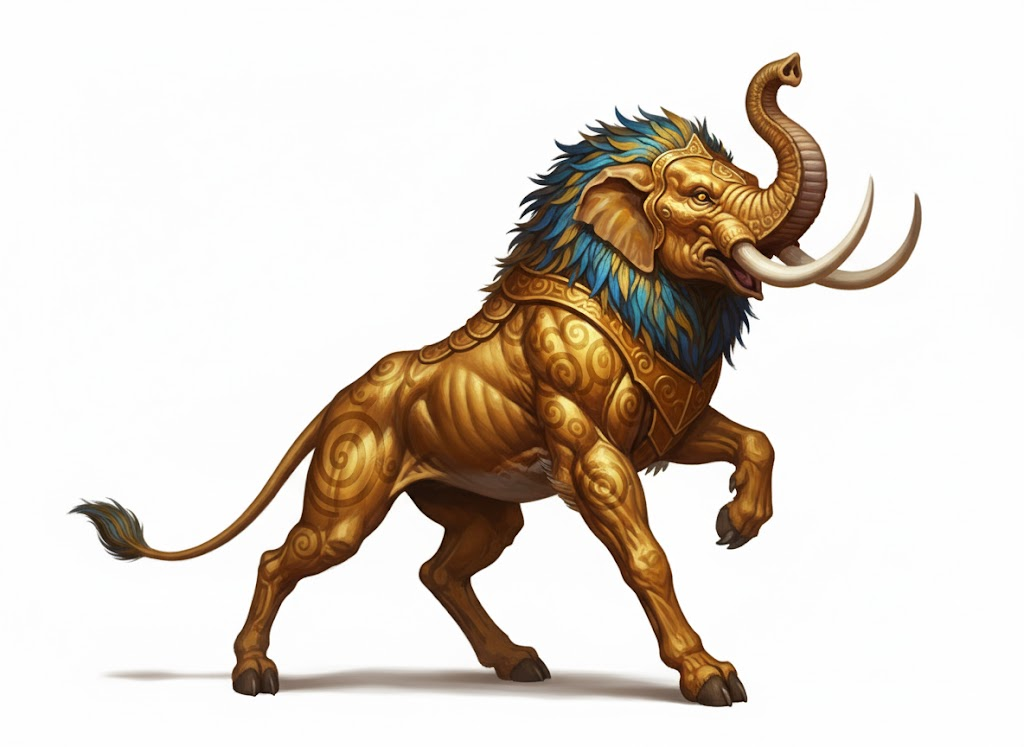
Temple guardians of Haukburia, yali combine a lion's golden body with an elephant's head, tusks, and trunk beneath a mane of peacock-bright feathers. Whorled markings run through the hide like script, and on holy days the temple grooms brighten them with gold dust until the beast seems cast from treasure. A yali's voice is half roar and half trumpet and carries for miles; its charge has been compared, by the walls that received it, to a living battering ram.
They are bred in temple stables, trained to gate-watch and procession, and given far more often than sold, an honor conferred on champions the temple wishes bound to it. The rare yali that changes hands for coin does so at a price that funds its home shrine for a season. Riders learn quickly that the trunk has its own opinions: it will pass up a dropped lance in the press of battle, and it will also help itself to any fruit within reach, including the rider's.
On Training and Tack
All prices assume a healthy, broken adult sold with basic tack by a reputable dealer; exceptional bloodlines command more. The riding price buys an animal steady on the road but liable to panic amid violence. The war-trained price buys a mount schooled to stay calm in battle and answer commands there. As ever, a mount must be at least one size larger than its rider, which is why the lanternpard seats only Tiny folk.
Barding can be fitted to most of these beasts, with the refusals and surcharges noted in each entry. Uncommon beasts are found only through the regions and peoples named in their entries, and rare beasts require the DM's blessing, a good story, or both. Click any portrait to see it at full size.

Return Home