
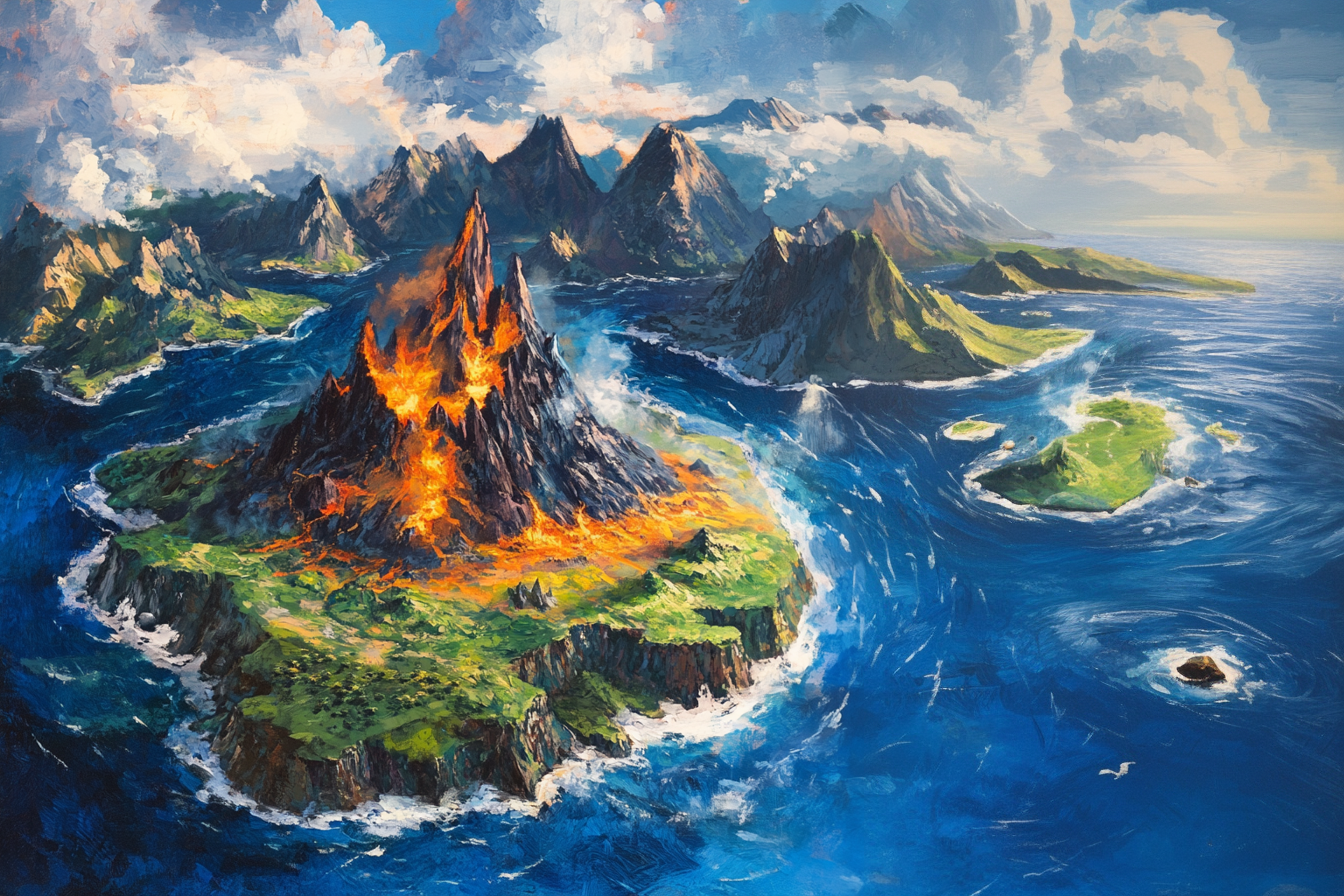
Kaihanga, crowned by the active volcano Mount Taimana, stands as the largest island in the chain. The Kaianga people, seafaring humans who have inhabited the island for countless generations, share the coastal regions with several maero strongholds. These fierce giants conduct their famous Riptide Combat tournaments in the deep waters off the island's eastern shores, where underwater currents are particularly treacherous. The island's interior valleys, perpetually shrouded in mist, harbor centuries-old patupaiarehe settlements, their pale forms glimpsed only during twilight hours when they emerge to perform their haunting flute music.
Moanaora Island, with its vast coral reef systems, exemplifies the delicate balance between its diverse inhabitants. The Moani human tribes work closely with the kakamora, the tiny coconut-like guardians who maintain the health of the reef ecosystems. Beneath the waves, ponaturi have established elaborate settlements in submarine caverns, emerging at night to trade and share their phosphorescent performances with surface dwellers. The kakamora's unique ability to influence coral growth has resulted in living architecture that serves both as homes and as natural barriers protecting the island's lagoons.
The twin islands of Tangaroa and Tangarei, separated by a deep channel that glows at night with bioluminescent organisms, serve as the spiritual nexus of the archipelago. The Tangaroan human clans maintain ancient stone platforms where the Maukoru Council gathers. These platforms were first discovered by menehune settlers, who recognized markings similar to those found in their ancestral lands. Today, the menehune craft halls dots both islands, their expert woodworking and stonecraft visible in every structure.
Wairua rises from the northern waters like a fortress, its cliffs home to both human settlements of the Wairui people and maero warrior societies. The island's natural harbor hosts the archipelago's largest fleet, jointly maintained by humans and menehune shipwrights. Deep underwater caves along the island's base shelter ponaturi communities who serve as night-time navigators for ships entering the treacherous harbor.
Kororua, the southernmost major island, houses the largest concentration of relluk temples and creation sites. The Kororu people, human custodians of ancient knowledge, work alongside the Archeopatroni society of the relluk to maintain these sites. The island's numerous thermal springs and volcanic vents provide the perfect conditions for creating new relluk bodies, while also supporting unique ecosystems protected by kakamora guardians.
The Maukoru Council represents all peoples of the archipelago, with representatives from each major racial group and human culture. Traditional human chiefs serve alongside maero warrior-leaders, kakamora elder guardians, menehune craft masters, patupaiarehe mist-speakers, ponaturi night-chiefs, and relluk Archeopatroni. The council's authority stems from ancient laws of hospitality and mutual protection, with each group contributing their unique strengths to the archipelago's defense and prosperity.
The human cultures of the Maukoru Archipelago maintain distinct traditions while sharing common values of navigation, respect for the sea, and reverence for ancestral wisdom. The Kaianga people are renowned astronomers, the Moani are master fishers, the Tangaroans are keepers of oral histories, the Wairui are accomplished warriors, and the Kororu are spiritual leaders and healers.
Maritime trade forms the foundation of the archipelago's economy, with specialized vessels designed by menehune craftsmen and human shipwrights plying established routes between islands. These ships often carry mixed crews, with ponaturi guides for night navigation and kakamora lookouts who can predict weather patterns through their connection to nature.
The archipelago's defensive network relies on the complementary strengths of its peoples. Maero warriors patrol the surface waters, while ponaturi monitor submarine approaches. Patupaiarehe mist-shapers can conceal entire harbors from hostile forces, and relluk guardians maintain ancient defensive positions. The kakamora's influence over marine life provides early warning of approaching dangers, while human and menehune vessels form the backbone of the archipelago's naval force.
Cultural practices reflect this integration, with festivals and ceremonies often combining multiple traditions. Human navigation ceremonies incorporate ponaturi phosphorescent displays and patupaiarehe music. Maero combat tournaments have evolved to include human participants in modified forms. Menehune crafting techniques have been adapted to work with kakamora coral-shaping abilities, creating unique architectural styles found nowhere else in the world.
The greatest challenges facing the Maukoru Archipelago come from both natural and political sources. Volcanic activity requires constant monitoring, with relluk sensors providing early warnings of impending eruptions. The complex weather patterns demand sophisticated understanding of seasonal changes, leading to the development of a unique predictive system combining human navigation knowledge with kakamora natural awareness. Additionally, maintaining harmony between the various peoples requires careful diplomacy, particularly regarding resource management and territorial rights.